

Central FS provides fire extinguisher servicing in Glasgow and across Central Scotland for businesses, landlords and anyone who holds the fire safety duty for a non-domestic building.
The service covers every portable extinguisher on your property, whatever the type and whoever supplied it.
Our BAFE accredited engineers carry out the annual basic service, the five-year extended service and the ten-year CO2 overhaul on-site to BS 5306, certify each unit, and leave you with the maintenance record an inspector or insurer will ask to see.
An extinguisher that has gone more than twelve months without a service isn’t being maintained in the way the Fire (Scotland) Act 2005 requires, and that responsibility sits with you as duty holder, whoever originally sold you the unit.
Why fire extinguisher servicing is a legal requirement in Scotland
Scottish fire safety law is devolved, so the rules that apply to a Glasgow workplace come from the Fire (Scotland) Act 2005 and the Fire Safety (Scotland) Regulations 2006, not the English fire safety order most online guidance quotes.
The 2006 Regulations require firefighting equipment to be kept in efficient working order and good repair.
The standard insurers and fire officers expect
Neither document names a service interval, so British Standards fill that gap through BS 5306-3, the UK code of practice for maintaining portable extinguishers and the standard a fire officer or insurer will measure you against.
Following it gives you evidence you complied, and skipping it means the first person to notice is likely to be a fire officer on an inspection, or a loss adjuster after a claim.
Insurers usually assume your fire safety equipment is maintained to the relevant standard.
A missing or out-of-date service label can be raised at claim time, even where the extinguisher had nothing to do with how the fire started.
A current label is what keeps you compliant, and it’s the first thing anyone checking your fire safety record will look for.
The BS 5306 service schedule
BS 5306-3 sets out four levels of attention, and the work climbs at each one. The lightest is a monthly visual check you do yourselves.
The fire warden walks the building and confirms each unit is in its bracket, unobstructed, pin and tamper seal intact, gauge in the green, then writes the date in the log book.
The annual basic service
Once a year a competent person has to go further than a look, and for a business in Glasgow that means one of our engineers on-site with the tools and spares to do the job properly.
The basic service is where most extinguishers either pass cleanly or reveal a fault that nobody noticed on the monthly walk-round.
Stored-pressure units are checked against the gauge, and where the reading looks doubtful, a gauge tester settles it properly and gives a reliable result.
CO2 extinguishers have no gauge, so each one is weighed and compared with the weight stamped on the cylinder, and a unit that has lost more than a tenth of its charge comes out of service for recharging or replacement.
Extended service at five and ten years
Every five years, water, foam, powder and wet chemical extinguishers get an extended service. The engineer discharges the unit, strips and inspects the body and internal parts, refills it with fresh agent and re-pressurises it.
Nothing short of a full discharge proves an extinguisher will empty as it should, so the standard builds one in every five years.
CO2 units run on a ten-year cycle instead, because the cylinder itself is the pressure vessel and needs a hydraulic pressure test as part of the overhaul.
We will tell you when a ten-year overhaul costs more than a new cylinder, which it often does, so you can choose replacement with your eyes open.
Different types of fire extinguishers
Central FS takes the time to understand your site to select the correct extinguisher for the building.
We work out the types of fire risks present and determine the appropriate number of units and sizes, alongside the locations they should be placed.
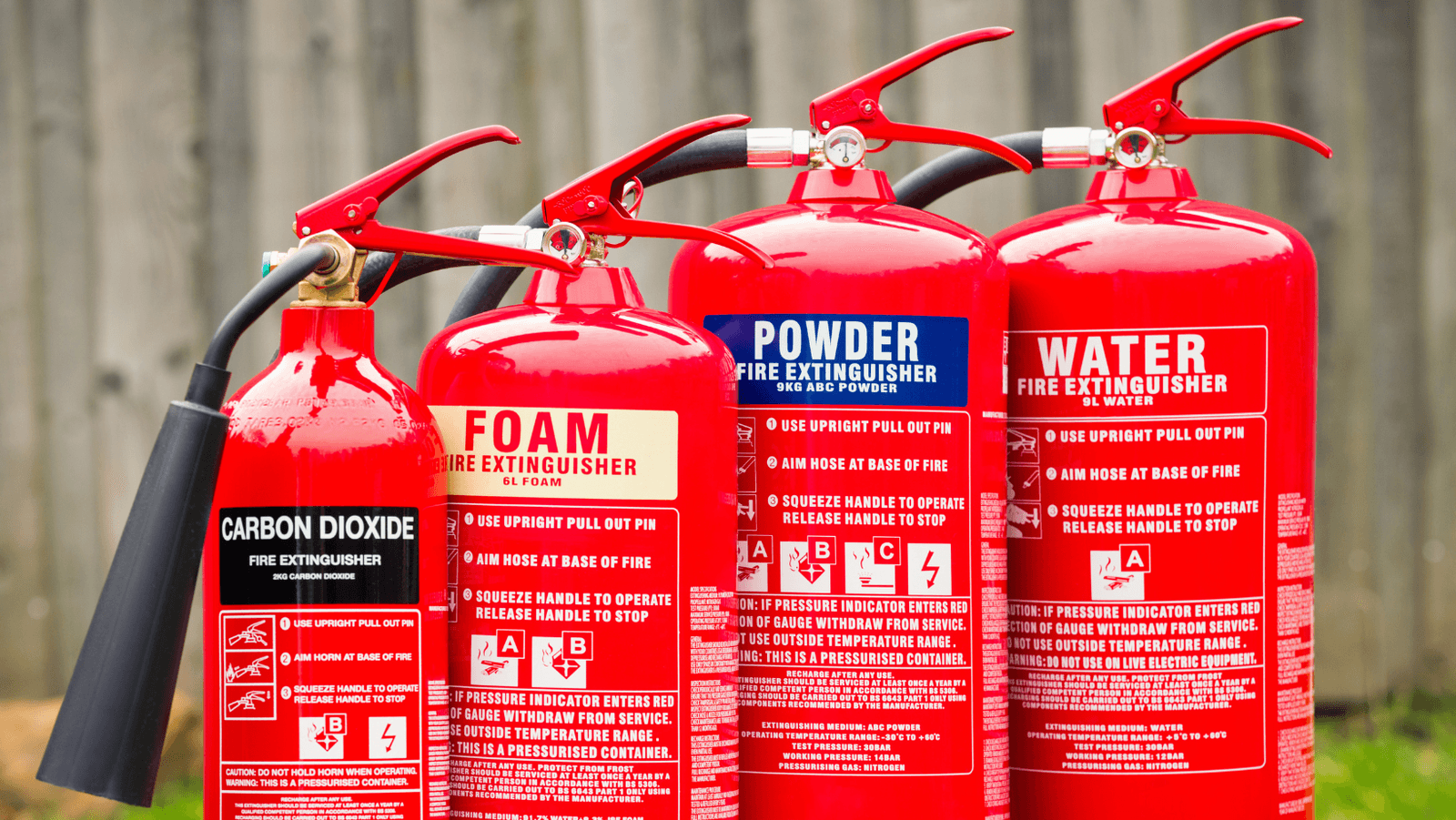
Our team works across four of the main types of fire extinguishers.
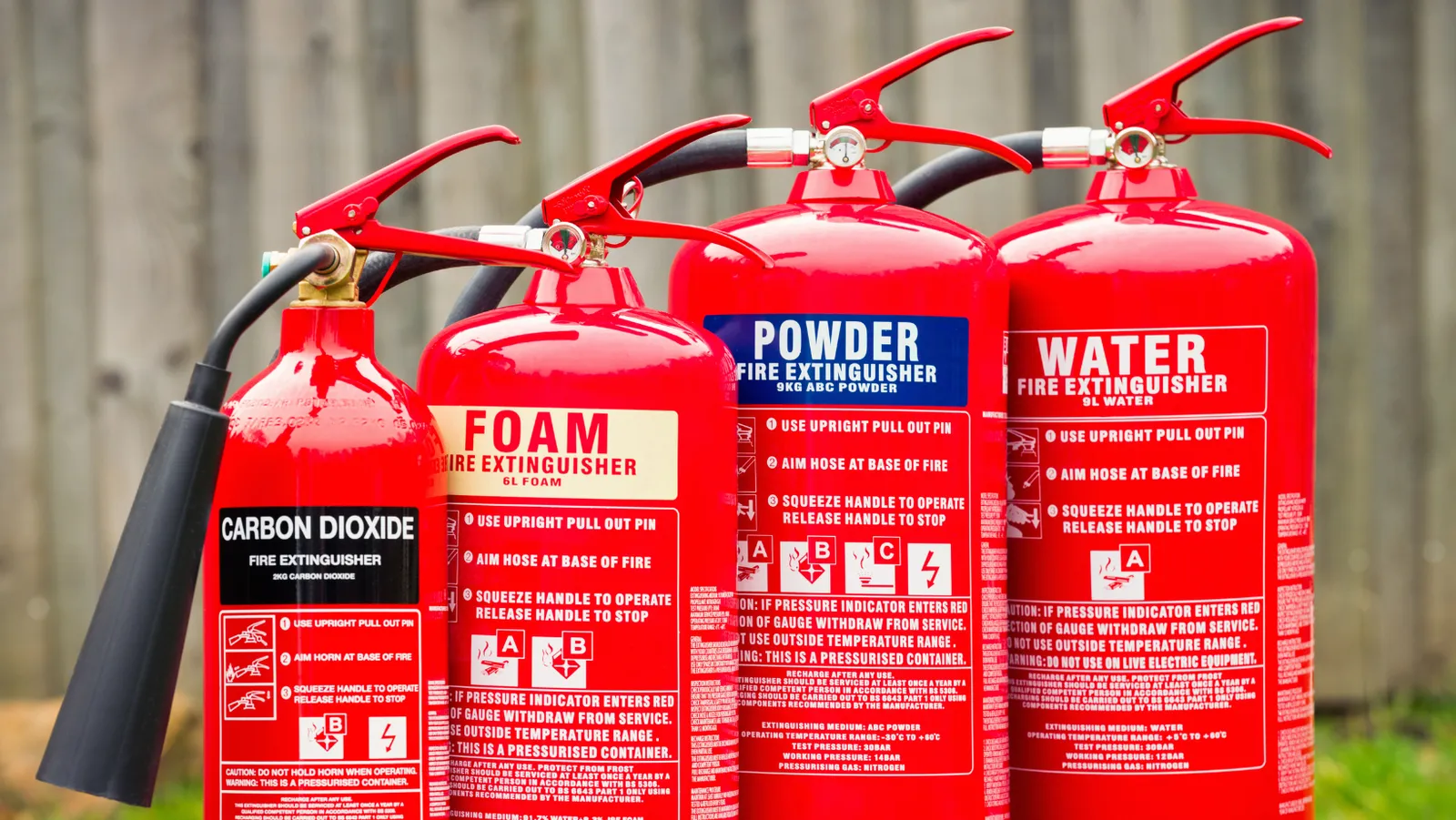
Water extinguishers (red label)
This is one of the most basic types of fire extinguishers and is identified by its red label.
Water is used to douse organic material such as wood, textiles, paper, as well as plastics. The highly pressurised jet of water soaks the area to prevent the fire from flaring back up.
Keep the extinguisher away from flammable liquids, as well as electrical fires.
Foam extinguisher (cream label)
Foam smothers a fire to cut off oxygen, making it effective on flammable materials such as wood, paper, fabric, and plastic fires.
Like water extinguishers, it cannot be used on electrical fires.
Carbon dioxide (CO2) extinguishers (black label)
CO2 floods the fire with gas, displacing the oxygen it needs to burn.
It does not conduct electricity, making it the standard choice for electrical fires.
However, it cannot be used in small, unventilated spaces.
Powder fire extinguishers (blue label)
One of the most versatile forms of fire extinguishers, it can be used on wood, paper, fabric, flammable liquids, gas fires, and live electrical equipment.
They do not cool the fire, so reignition is a risk once you stop spraying.
Training your team and appropriate signage
A fire extinguisher is only effective if people have the knowledge to use them appropriately.
We provide fire extinguisher training which covers which extinguisher is appropriate for which flame. The training also covers how to operate the extinguisher safely, and when to prioritise safe evacuation over tackling the fire yourself.
For sites with higher risks or with regular staff turnover, we offer refresher training to ensure everyone is up-to-date, including new staff members.
Central FS also put up signage to help refresh memory in the event of a fire. Every fire extinguisher point is fitted with clear signage, so the right guidance is there when needed.
Fire hoses, blankets, and reels
Larger premises may require fire hose reels to cover the ground that an extinguisher can’t.
Any kitchen or workshop should also have a fire blanket to smother fires.
We supply, maintain, and provide training to ensure these systems are set up properly.
What happens during a fire extinguisher service visit
Every visit follows this typical order.
On the day
- Book a date that suits the building. We work around opening hours for shops and cafés in Glasgow, with visits before opening or at the end of the day. For an office, a quiet weekday may be more convenient.
- Walk the premises with you and log every unit by type, size, location and last service date, so the engineer has a proper register of exactly what should be there.
- Service each extinguisher in turn. That includes the pressure or weight check above, the headcap, hose, horn and nozzle, the operating mechanism, the safety pin and tamper seal, the body for corrosion or dents, the bracket height and the signage beside it.
- If necessary, we provide fire extinguisher training and refresher courses to demonstrate how to safely operate the extinguisher.
Sorting anything that’s wrong
- Deal with anything that fails. Worn seals and pins are replaced on the spot, and a unit that can’t be brought back to standard is condemned, replaced and taken away for disposal.
- Write up the service label on each extinguisher with the date, the work done and the engineer’s details, then issue your certificate and update the record we hold for you, paperwork you can trust when an inspector or insurer asks to see it.
Before the engineer leaves, you get an easy-to-understand summary of anything that needs a decision from you, whether that’s a replacement, a missing sign or a unit that has ended up in the wrong place.
Failed units, refills and replacements
Corrosion around the base, a dented body, a gauge stuck in the red, a CO2 cylinder past its test date or a discharged unit still hanging in its bracket all mean the extinguisher comes out of service that day.
We recharge a unit where a refill makes sense, and replace and commission a new one on the same visit where it doesn’t, so there’s no gap in your cover.
Old cylinders are pressurised and can’t go in a skip, so we take them away and dispose of them properly.
If the visit shows you’re short of extinguishers altogether, or carrying the wrong types for the specific risks in the building, we can supply what is missing from the wide range we stock, with installation and commissioning done on the same visit.
Everything gets added to your maintenance schedule from day one.
Servicing and your fire risk assessments
Your fire risk assessment decides how many extinguishers the building needs and which types, and the annual service is how you keep that assessment accurate from one year to the next.
Your assessment needs updating when you bring in new equipment or change the layout, including how and where you store things.
Our engineers check each unit’s position against the assessment for that area and correct any siting problems during the visit. They also identify any extinguishers that are missing so we can put those gaps right.
If the risk assessment itself is overdue, the same visit is a sensible time to book one.
Fire extinguisher maintenance contracts across Glasgow and Scotland
Under an annual maintenance contract, we keep a register of your extinguishers with the dates each basic and extended service falls due. We’ll contact you in plenty of time to arrange the next visit.
For a landlord with several properties, servicing and maintenance runs off a single schedule. The same applies to businesses with sites spread across Scotland. Where we also carry out your fire risk assessments, we can line those up on the same renewal dates too.
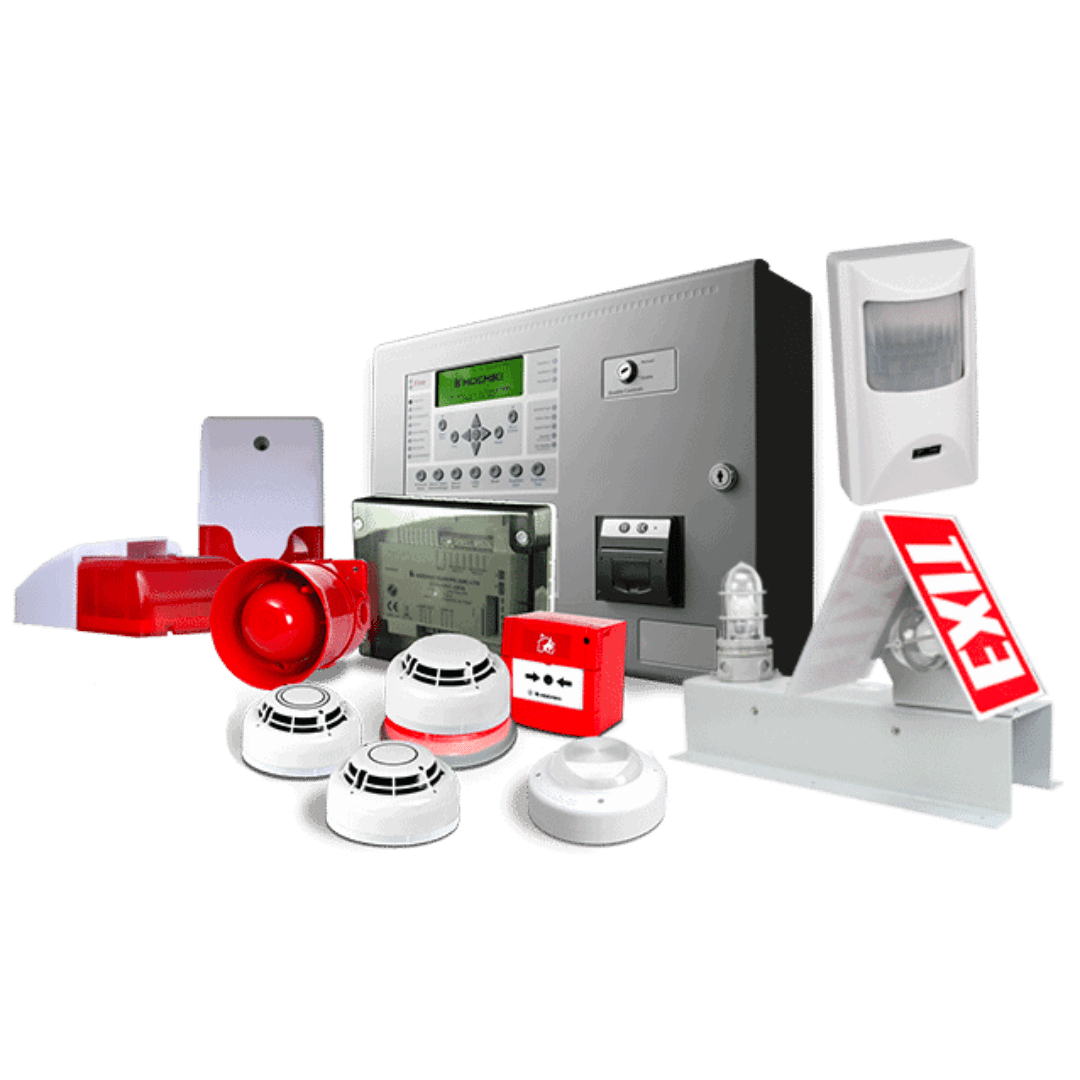
We also carry out security and electrical work, so your contract can cover more than extinguishers. We can include your fire alarm servicing alongside emergency lighting, with portable appliance testing handled by the same company.
The work is billed on one invoice, and the records stay together in a single compliance file.
Pricing is worked out per extinguisher at competitive rates, so what you pay reflects what’s actually on your walls, and the quote itself costs nothing.
Fire extinguisher servicing for businesses across Glasgow
Businesses across Glasgow make up most of the work on fire extinguishers, from single shops and cafés in the city centre to offices, warehouses, gyms, care homes, schools and hospitality venues.
We also service the extinguishers in common stairs and HMOs for landlords and letting agents, and cover the annual certified service for facilities teams who already have the monthly checks in hand.
From our Kinning Park office we cover Glasgow and the surrounding areas, including Cambuslang, Rutherglen, Clydebank, Paisley, East Kilbride and Cumbernauld, with Ayr, Dumfries and Edinburgh reached from the same base.
Our Perth office picks up Dundee, Fife and the east, so between the two bases we cover fire protection services across Scotland.
Why choose Central FS for fire extinguisher servicing
Accredited, qualified engineers
We are BAFE accredited and independent of any manufacturer, so a recommendation to refill, replace or leave a unit alone is based on what the standard says about that extinguisher and nothing else.
Our engineers and technicians are fully trained and fully qualified to service and certify to BS 5306, and their years of experience in the fire industry mean they know the models on your wall.
Nearly half our engineering team came through our own apprenticeship programme, so the people we send out were trained to our standard from the start.
One team for the lot
A replacement or a missed extended service is a short drive from our Kinning Park base, so it gets sorted quickly.
Between visits, your fire safety questions go straight to one of our own engineers.
Extinguisher servicing sits alongside the rest of our fire safety services, from alarms to risk assessments, and the same team delivers all of it.
We specialise in all three trades under one roof, so the quality service you get on your extinguishers is measured against the same BAFE standard as everything else we do.
Fire extinguisher servicing questions in Glasgow
How often do fire extinguishers require servicing?
At least once every twelve months. A basic service every year is the standard under BS 5306, with an extended service due at five years and a CO2 overhaul at ten. Keeping to that schedule is how a business meets its maintenance duty under the Fire (Scotland) Act 2005.
Do you service extinguishers you did not supply?
The standard applies to the extinguisher itself, whoever supplied it, so we service and certify units from any manufacturer, including ones fitted by a previous contractor or left behind by the last tenant. If we find a unit with no service history at all, we treat it as due for an extended service so your record starts clean.
What happens if an extinguisher fails its service?
The engineer tells you on the day, explains why, and either refills it or condemns it. A condemned unit is replaced, usually on the same visit, and taken away for disposal, so you’re not left with an empty bracket on the wall. Nothing is replaced without you agreeing the cost first.
Get your extinguishers back in date
If you can’t remember when your extinguishers were last serviced, or the labels show a date that has been and gone, that’s the point to call. A thorough survey tells us exactly where you stand, and whether you comply.
Our Glasgow office is on 0141 530 1244, Perth is on 01738 500006, and info@centralfs.co.uk reaches both.
Tell us roughly how many units you have and where they are so we can quote for the work. Once you’re happy to go ahead, we’ll arrange the engineer’s visit and keep track of future service dates for you.