

Central FS undertakes fire extinguisher servicing in Dennistoun and throughout Scotland for businesses, landlords and anybody in charge of fire safety in a non-domestic building.
Our service covers each portable extinguisher across your property, regardless of its type or supplier.
Our BAFE accredited engineers carry out the annual basic service, five year extended service and ten year CO2 overhaul on site, in line with BS 5306. The engineers certify every unit and supply the maintenance record inspectors and insurers will want to see.
If an extinguisher has remained unserviced for over twelve months, it is not being maintained as required by the Fire (Scotland) Act 2005. As the duty holder, you are still responsible, regardless of who originally sold you the unit.
Exploring why fire extinguisher upkeep is a compulsory responsibility in Scotland under Dennistoun
Scotland controls its own fire safety laws, therefore a Dennistoun worksite must follow the Fire (Scotland) Act 2005 and Fire Safety (Scotland) Regulations 2006, rather than the English fire safety order referenced in a lot of online guidance.
Under the 2006 Regulations, firefighting equipment is required to remain in efficient working order and good repair.
The typical insurers and fire marshals stipulate
Neither document specifies a service interval, so BS 5306-3 fills the gap as the UK code of practice for maintaining portable extinguishers and the benchmark against which a fire officer or insurer will assess you.
Completing it provides evidence of your compliance, whereas omitting it indicates the first to identify that omission will probably be a fire officer at an inspection or a loss adjuster following a claim.
Insurance providers usually expect your fire safety equipment to be maintained in accordance with the applicable standard.
A missing or out-of-date service label may still be challenged during a claim, even if the extinguisher played no part in starting the fire.
A up-to-date label supports compliance, and it is the first detail anyone reviewing your fire safety record will seek.
The standard BS 5306 inspection schedule for Dennistoun buildings
BS 5306-3 defines four levels of attention, with work increasing at every stage. The least demanding is a monthly visual inspection carried out by your own team.
The fire warden checks the building, confirming that each unit is properly positioned in its bracket and unobstructed, with its pin and tamper seal undamaged and gauge showing green, before entering the date in the log book.
The annual standard support
Annually, a competent person must conduct more than a visual inspection, and for a business in Dennistoun, this means having one of our engineers on site, supplied with the necessary tools and spares to finish the work properly.
The basic service is the point at which the majority of extinguishers either pass without concern or reveal a fault overlooked during the monthly walk round.
Technicians compare stored pressure units against the gauge. If the reading appears uncertain, a gauge tester verifies it and returns a trustworthy result.
As CO2 extinguishers are not fitted with a gauge, every one is weighed against the figure stamped on its cylinder. If it has lost more than one tenth of its charge, it is taken out of service to be recharged or replaced.
Continued dedication at 5 and ten years
Every five years, water, foam, powder and wet chemical extinguishers undergo an extended service. The engineer drains the unit, dismantles and inspects its body and internal components, refills it with fresh agent and repressurises it.
Just a full discharge verifies that an extinguisher empties correctly, which is why the standard requires one every five years.
CO2 units follow a ten year cycle instead, as the cylinder serves as the pressure vessel and requires a hydraulic pressure test during its overhaul.
We’ll tell you when a ten-year overhaul costs more than a new cylinder, which it often does, so you can decide on a replacement with your eyes open.
Diverse forms of fire extinguishers
Central FS thoroughly assesses your site before selecting the extinguisher most suitable for the building.
We assess the fire risks present, then establish the appropriate number and sizes of units, along with the locations where they should be positioned.
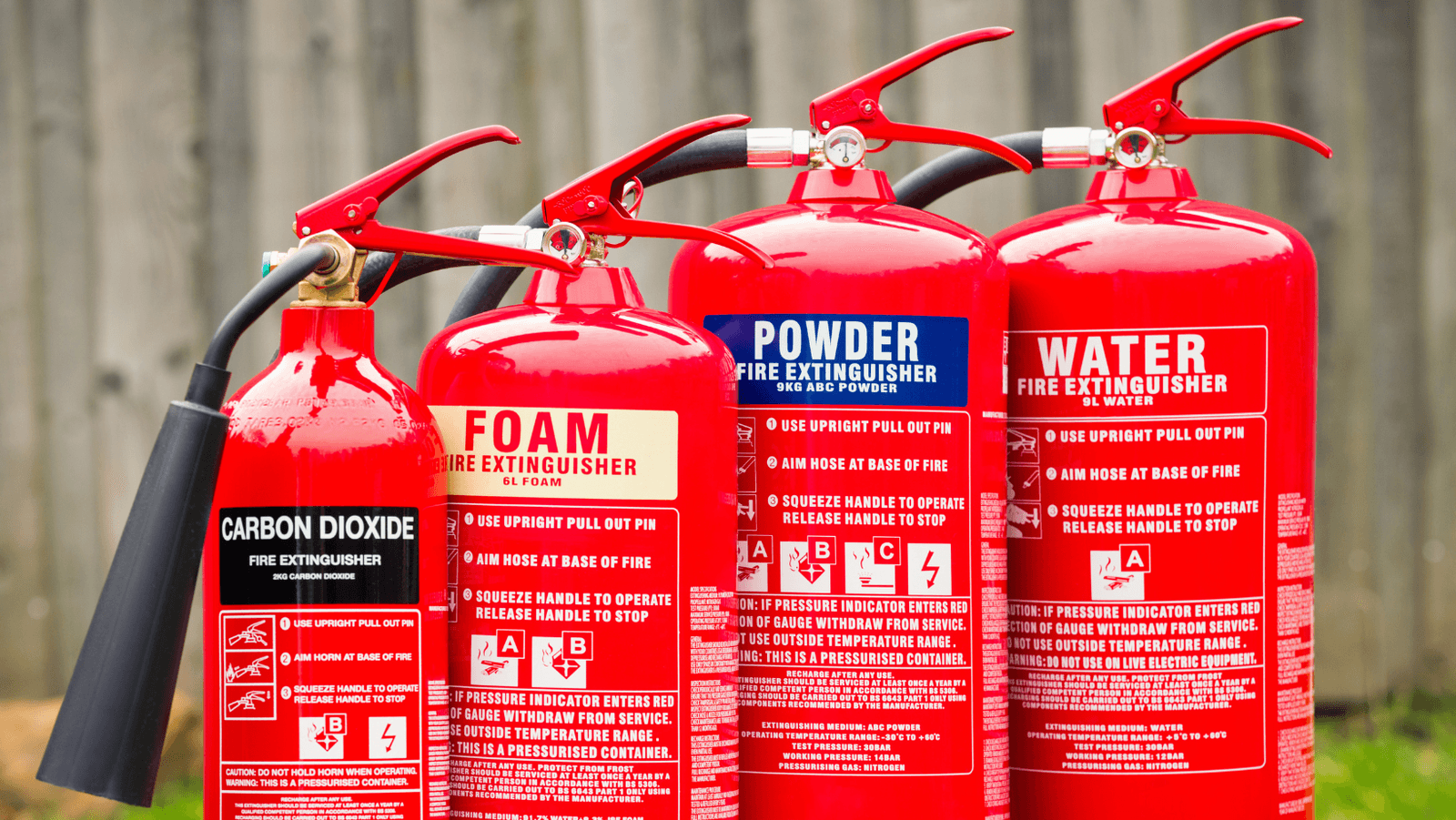
Our team covers four of the key types of fire extinguishers.
Water extinguishers that have a red label
This fire extinguisher is among the simplest available and can be recognised by its red label.
Water is used for extinguishing organic materials, including wood, textiles, paper and plastics. Its high-pressure jet soaks the area, helping to stop the fire from flaring up once more.
Position the extinguisher at a distance from flammable liquids and electrical fires alike.
Foamy extinguisher that have a cream tag
Foam suppresses flames by restricting oxygen, which makes it suitable for fires involving combustible materials such as wood, paper, fabric and plastic.
Like water extinguishers, it must not be used on electrical fires.
CO2 fire suppression devices with a black band
CO2 envelops the fire in gas, displacing the oxygen necessary for combustion.
It doesn’t conduct electricity, making it the go-to choice for fires involving electrical equipment.
However, it is unsuited for small spaces without sufficient ventilation.
Powder fire extinguishers with blue markings
Among the most versatile fire extinguishers, it tackles wood, paper, fabric, flammable liquids, gas fires and live electrical equipment.
Since they fail to cool the fire, it may reignite when spraying ceases.
Educating your staff and adequate signage
A fire extinguisher can only protect people if they know how to use it properly.
Our fire extinguisher training sets out which extinguisher is suitable for each type of flame, how to use it safely, and when a safe evacuation should take precedence over trying to tackle the fire on your own.
{For sites with higher risks or with regular staff turnover, we offer refresher sessions to keep everyone up to date, including any new starters}.
Central FS has also installed signage to strengthen awareness if a fire occurs. Clear notices are placed at each fire extinguisher point, ensuring essential guidance is available whenever it is required.
Fire hoses, blankets, and reels
Within bigger premises, fire hose reels may be needed to reach parts extinguishers cannot reach.
Each kitchen or workshop should have a fire blanket to smother fires.
We provide and service these systems, while providing training to ensure their proper installation.
What exactly happens throughout a extinguisher for fires service booking?
Here’s how each visit typically proceeds!
On the same day
Select a booking that suits the building’s schedule. In Dennistoun, we can call at shops and cafés prior to opening or after closing. Offices may consider a quiet weekday more appropriate.
Walk the premises with you, documenting every unit’s type, size, location and latest service date, so the engineer has an precise register of everything that ought to be present.
Examine each extinguisher individually. This includes the pressure or weight check described above, the headcap, hose, horn and nozzle, the operating mechanism, safety pin and tamper seal, the body for signs of corrosion or dents, the bracket height, and the signage placed beside it.
When required, we provide fire extinguisher training and refresher courses, showing participants how to use the extinguisher safely.
Organising all items that’s wrong
Any faulty item is addressed immediately. Worn seals and pins are replaced during the visit, while any unit which cannot be restored to the required standard is condemned, replaced and removed for disposal.
We writes up the service label on each extinguisher with the date, the work done and the engineer’s details, then issues your certificate and updates the record we hold for you, paperwork you can trust when an inspector or insurer asks to see it.
Prior to the engineer departs, you receive a straightforward, easy to understand summary of each matter needing your decision, from a replacement or absent sign to an incorrectly positioned unit.
Failed components top-ups and exchanges
Corrosion at the base, a dent-marked body, a gauge in the red, a CO2 cylinder beyond its test date, or a discharged unit left in its bracket means the extinguisher must be withdrawn from service that day.
We recharge a unit when refilling is appropriate, or replace and commission a new one on the same visit when it is not, so that your cover does not lapse.
Old cylinders stay pressurised, so they cannot be placed in a skip. We remove them and make sure they are disposed of correctly.
If the visit reveals that your building has no extinguishers at all or has unsuitable types for its particular risks, we can provide the required equipment from our extensive stock, with installation and commissioning carried out during the single visit.
It all is included in your maintenance schedule from the outset!
Servicing and your business’s fire risk reviews
Your fire risk assessment establishes the building’s extinguisher requirements and types, while annual servicing maintains its accuracy year after year.
Revisit your assessment whenever new equipment is introduced or the layout changes, including the storage arrangements for items.
During each visit, our engineers compare every unit’s location against the relevant area assessment, resolve any siting issues, and detect missing extinguishers so those gaps can be addressed.
If the risk assessment is overdue, utilise the same visit to organise it.
Blaze extinguisher servicing plans serving Dennistoun and Scotland
As part of your annual maintenance contract, we maintain a record of your extinguishers and note when each basic and extended service is due. We will contact you well in advance to schedule your next visit.
For property owners managing several properties, servicing and maintenance can follow one schedule. The same approach works for businesses with sites throughout Scotland. If we also carry out your fire risk assessments, we can align them with those same renewal dates.
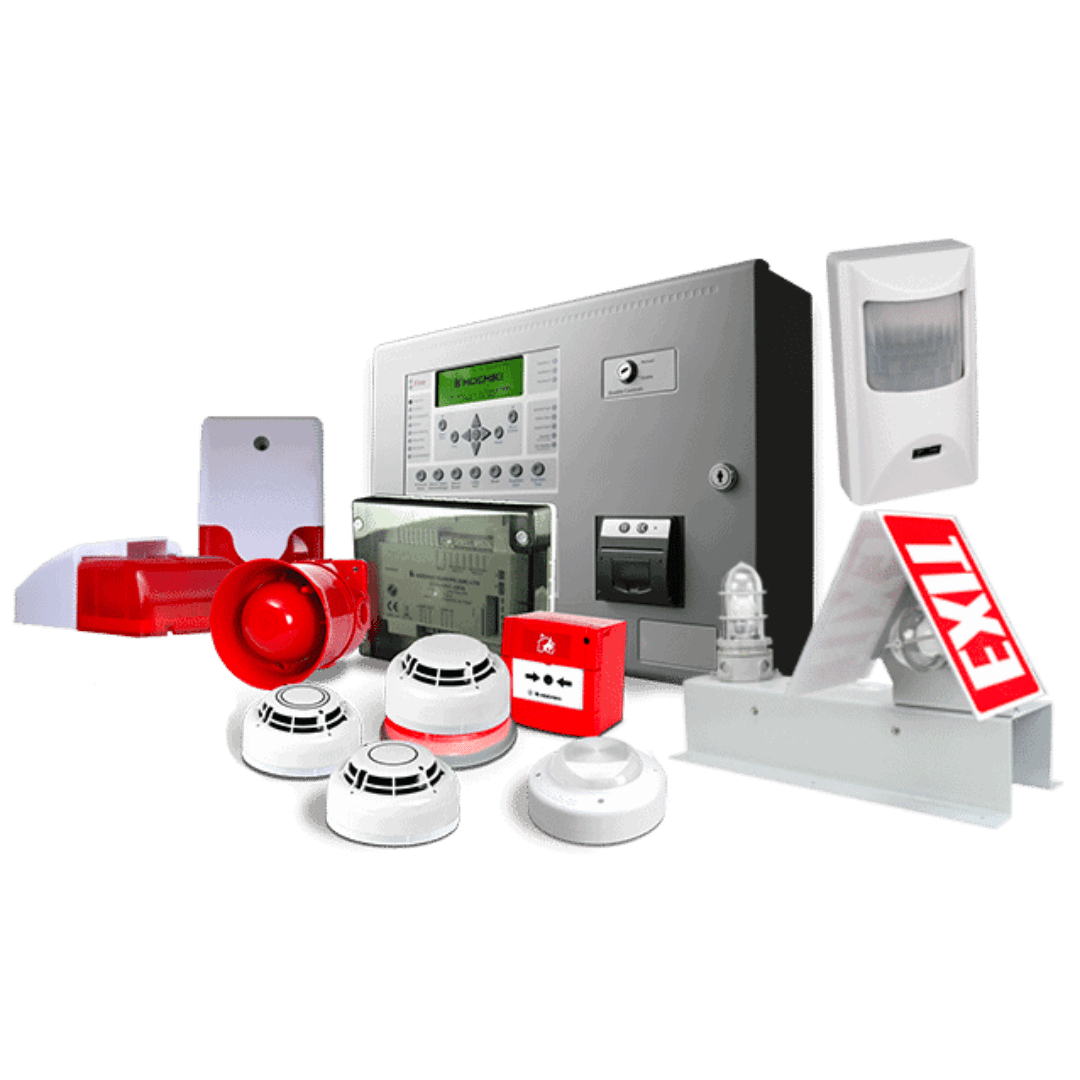
We additionally provide security and electrical services, allowing your contract to extend beyond extinguishers. Your fire alarm servicing can be combined with emergency lighting, while the same company takes care of portable appliance testing.
The work appears on a single invoice, whilst all records remain together inside a one compliance file.
Every extinguisher is priced at a competitive rate, meaning you only pay for what is actually installed on your walls, and your quotation is free of charge!
Fire extinguisher inspection for businesses through Dennistoun
Across Dennistoun, businesses account for most fire extinguisher work, from individual city centre shops and cafés to offices, warehouses, gyms, care homes, schools and hospitality venues.
We additionally service extinguishers in common stairs and HMOs for landlords and letting agents, whilst providing annual certified servicing for facilities teams managing their own monthly checks.
From our Kinning Park office, we serve Glasgow and surrounding areas, such as Cambuslang, Rutherglen, Clydebank, Paisley, East Kilbride and Cumbernauld, while Ayr, Dumfries and Edinburgh are covered as well from this office.
Our Perth office covers Dundee, Fife and the east, whereas our two bases combined deliver fire protection services across Scotland.
Why pick Central FS for fire extinguisher maintenance
Qualified, certified engineers
We hold BAFE accreditation and remain independent of every manufacturer, meaning that any recommendation to refill, replace or retain a unit is based solely on the applicable standard for that extinguisher.
Our engineers and technicians are fully qualified and fully trained to certify and service to BS 5306, and their years of experience in the fire industry mean they know the models on your wall.}
Almost half of our engineering team finished our own apprenticeship programme, meaning the people we send out were trained to our standard from the very beginning.
A single team for everything.
A replacement or a missed extended service gets sorted quickly by the Central FS team.
Between visits, one of our own engineers responds to your fire safety questions directly.
Our extinguisher servicing operates alongside every fire safety service we provide, from alarms to risk assessments, each provided by one dedicated team.
We bring together all three trades under one roof, meaning your extinguisher service complies with the same BAFE standard that guides all other service we provide.
Obtain your Dennistoun’s extinguishers valid again
If you cannot recall when your extinguishers were last serviced in Dennistoun, or their labels display an expired date, it is time to get in touch with us. A comprehensive survey determines your exact position and confirms whether you are still compliant.
Contact our Glasgow office on 0141 530 1244, our Perth office on 01738 500006, or both via info@centralfs.co.uk.
Please tell us approximately how many units you have and where they are, so we can produce your quote for the work. Ready to proceed? We’ll organise the engineer’s visit to your Dennistoun location and keep track of future service dates for you.